AI in B2B sales is often framed as a future advantage. But for industrial manufacturers, the return on AI is already measurable—and increasingly difficult to ignore.
Across Supplyco deployments with over 15 machine manufacturers, robotics companies, and industrial distributors, we consistently see the same pattern: sales teams are overloaded, thousands of potential customers take actions every day that are impossible to monitor manually, and valuable buying signals are missed simply because no one has time to catch them.
This article breaks down the real ROI of AI in B2B sales, using concrete results observed across Supplyco customer work—focusing on time saved, pipeline impact, and conversion lift in complex industrial sales environments.
The Hidden Cost in Industrial Sales: Time
Picture this: Your top sales rep starts Monday morning with good intentions. She plans to follow up on three promising accounts, research two new expansion opportunities she heard about at a trade show, and finally update that backlog of CRM records from last week's customer visits.
By Tuesday afternoon, she's still stuck. One customer called with an urgent technical question. Another needed a revised quote. Email ate an hour. The CRM updates? Still not done. The expansion opportunities? She bookmarked the articles but hasn't had time to dig in.
By Friday, those two expansion opportunities are being quoted by a competitor who got there first.
This is the invisible tax on industrial sales teams: strategic work loses to urgent work, every single time.
Industrial sales teams don't lose deals because they lack effort. They lose deals because time is consumed in the wrong places.
From customer discovery and pilot work, we consistently see:
- Reps managing 1,000–1,200 accounts each
- Manual research across websites, trade journals, government filings, LinkedIn, Google Alerts, and CRM
- Follow-ups driven by memory rather than signals
- Hours of post-visit CRM cleanup after customer meetings
In multiple deployments, sales reps reported spending 8–10 hours per week on manual prospecting, research, and CRM administration—time that does not directly generate revenue.
What AI Changes
When AI handles:
- Market monitoring
- Account prioritization
- Signal detection
- CRM write-back
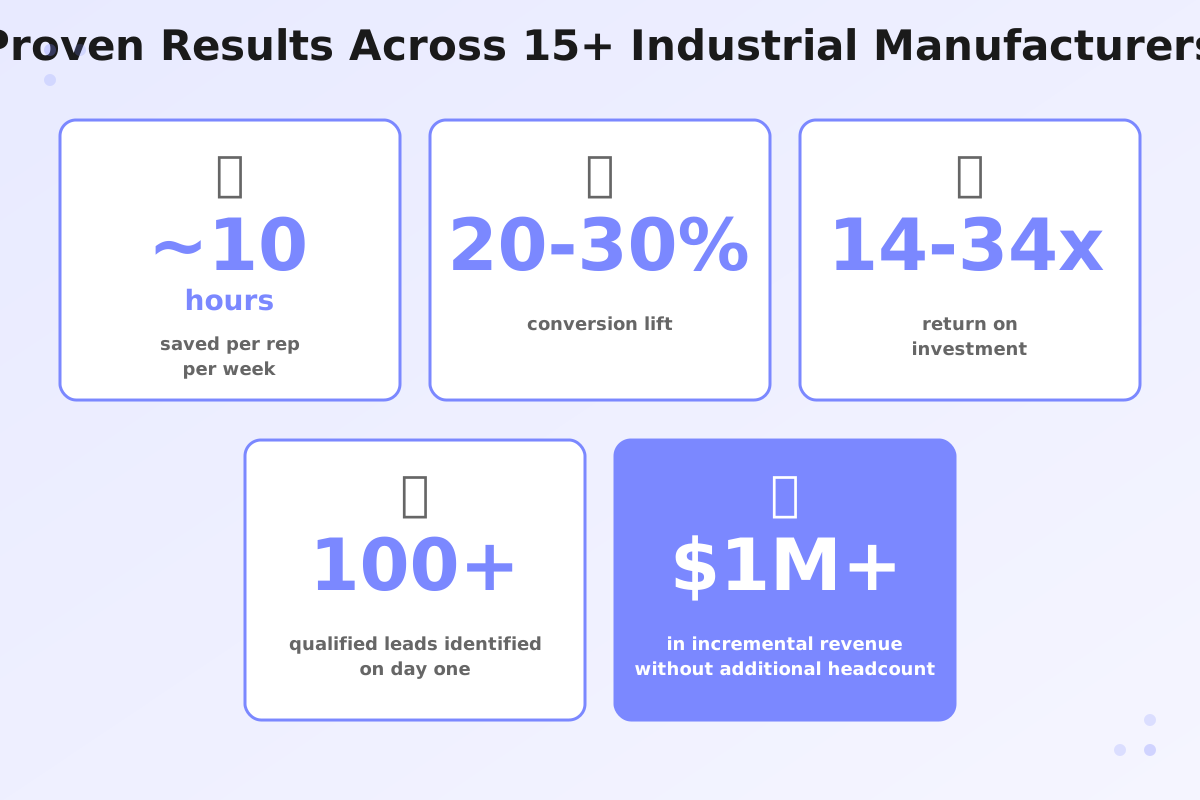
Sales teams consistently recover ~10 hours per rep per week, based on Supplyco onboarding benchmarks and customer usage data.
That's not theoretical efficiency—it's reclaimed selling time. Time that can be spent having conversations, building relationships, and closing deals.
Pipeline Impact: More Opportunities, Earlier
AI's biggest impact in industrial sales isn't volume—it's timing.
Across Supplyco pilots:
- Customers identified 100+ qualified, pre-vetted leads on day one
- Sales teams moved from reactive inbound to proactive outbound
- Opportunities surfaced weeks or months earlier than before
In several customer environments, this resulted in:
- 2–3× increase in outbound activity
- More quoted opportunities without adding headcount
- Earlier engagement in procurement cycles
Because industrial deals are large and infrequent, even a small shift in timing has an outsized effect on pipeline.
Consider the Kawasaki Robotics case study (see Supplyco Blog) where early signal detection enabled the sales team to engage prospects during the planning phase rather than the vendor selection phase—fundamentally changing their competitive position.
Conversion Lift: Focus Beats Hustle
One of the most consistent results across Supplyco customer work is conversion improvement.
When sales reps are guided toward:
- Accounts with verified buying signals
- The right contact at the right moment
- Clear next actions instead of open-ended research
They close more deals.
Across multiple customer deployments, Supplyco customers observed:
- 20–30% conversion lift
- Fewer stalled opportunities
- Less effort spent on low-probability accounts
This lift isn't driven by better scripts or harder selling—it comes from focus. Reps spend their time where deals are most likely to happen.
A Realistic ROI Scenario
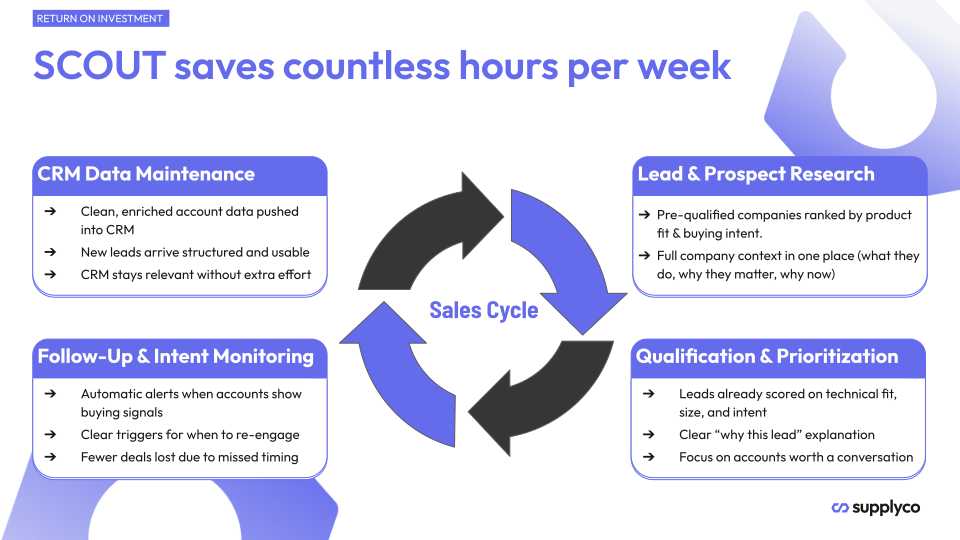
How SCOUT transforms every stage of the sales cycle—from CRM maintenance to follow-up monitoring
Consider a mid-sized industrial sales team:
- 15 reps
- Each saving ~10 hours per week
- That's 7,800 hours recovered annually
If even a fraction of that time converts into:
- Earlier engagement
- Better follow-ups
- One additional closed deal per rep per year
The revenue impact quickly reaches seven figures.
Show Image
Time & Costs Saved:
- Lead & Prospect Research: 1-3 hrs/week → $240-$400/week
- Qualification & Prioritization: 1-2 hrs/week → $80-$240/week
- Follow-Up & Intent Monitoring: 2-3 hrs/week → $160-$320/week
- CRM Data Maintenance: 1-2 hrs/week → $80-$160/week
Total Time Saved: 5-10 hrs/week
Total Costs Saved: $400-$800/week
Potential Sales Impact:
- +20-30% additional new opportunities contacted
- +10-30% conversion from outreach
- +2-5% additional sales from reactivating past prospects
Average Additional Deals: 8-20
Average Additional Sales: $800k-$2M
ROI (annual):
- Cost Saved: $208k-$416k/year
- Additional Revenue: $800k-$2M/year
- Cost of Platform: $69,600/year
- Return on Investment: 14-34x
In fact, across Supplyco customer work, teams have unlocked $1M+ in incremental revenue, without hiring additional SDRs, agencies, or data providers.
Why Industrial Sales See Outsized Returns from AI
AI delivers ROI everywhere—but industrial sales magnify its impact because:
- Deals are high-value (often $100k-$5M+)
- Sales cycles are long (12-24 months)
- Buying triggers are external and event-driven (facility expansions, capex approvals, regulatory changes)
- Missed timing can cost millions
When a sales team learns about a new facility expansion, capex investment, or equipment upgrade after a competitor, the loss is rarely recoverable.
AI prevents that.
For more on how traditional CRM falls short in capturing these opportunities, read our article on Why Traditional CRM Isn't Enough for Modern Manufacturers.
ROI Beyond the Spreadsheet
Some of the most important returns aren't immediately financial:
- More predictable forecasting based on real market signals
- Better manager visibility into real activity, not just logged calls
- Reduced burnout from wasted effort on dead-end prospects
- Faster onboarding for new reps who inherit institutional knowledge
- Stronger trust in data across the organization
Over time, these effects compound into a sales organization that isn't just faster—but more resilient.
The Bottom Line
The ROI case for AI in B2B sales—especially industrial sales—is no longer hypothetical.
Supplyco customers are already seeing:
For industrial sales leaders, the real question is no longer whether AI delivers ROI.
It's how long you can afford to keep selling without it.
Every week without AI-powered intelligence is another week your competitors are engaging prospects earlier, with better information, and closing deals you never even knew existed.
Disclaimers: All figures are indicative estimates based on observed customer usage and conservative assumptions. Actual results may vary based on team size, deal value, and implementation approach.